Jargon Buster
Why Do MotoGP Bikes Have Smooth Tyres?
Ever wondered why MotoGP bikes use smooth, treadless tyres? We break down the science of slicks, compounds, and grip for absolute beginners.
Independent fan site — not affiliated with MotoGP or MotoGP Sports Entertainment Group (formerly Dorna). Written by AI from official data and fact-checked: how this article was made.
The Strangest Looking Tyres in Motorsport
If you look at the tyres on your car or a normal road-going motorcycle, you’ll see they are covered in grooves and patterns. Now, look at a MotoGP bike ready to race. Its tyres are completely smooth, like a black billiard ball. It seems wrong, doesn’t it? Surely, no pattern means no grip?
It’s one of the first things beginners notice, and it’s a great question. In the world of high-speed racing, those smooth tyres – called ‘slicks’ – are the secret to the almost supernatural performance of a MotoGP machine. Let’s break down why smooth is best when you’re on a dry racetrack.
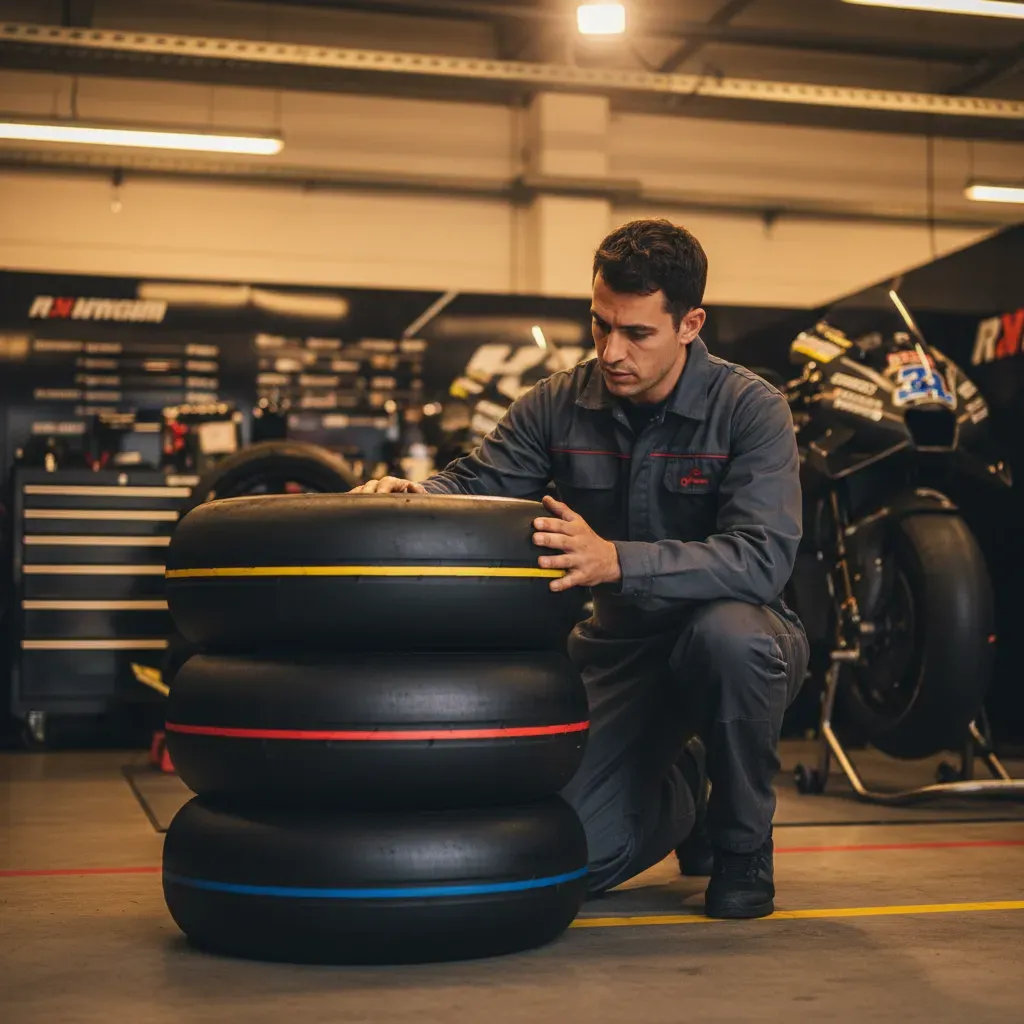
Jargon Buster: Slick Tyres
Slick Tyre: A racing tyre with a completely smooth surface and no tread pattern.
You will hear commentators and teams talking about ‘slicks’ all the time during a dry race weekend. They are the standard, default tyre choice for every team as long as the track surface is not wet. They are designed for one thing and one thing only: maximum grip in dry conditions.
This matters because the entire performance of a MotoGP bike – its incredible cornering speed, its powerful braking, and its ferocious acceleration – relies on the grip generated by these tyres. A common confusion is thinking that a smooth tyre is like a ‘bald’ car tyre, which is dangerous. In racing, on a dry track, the exact opposite is true.
The Magic of the ‘Contact Patch’
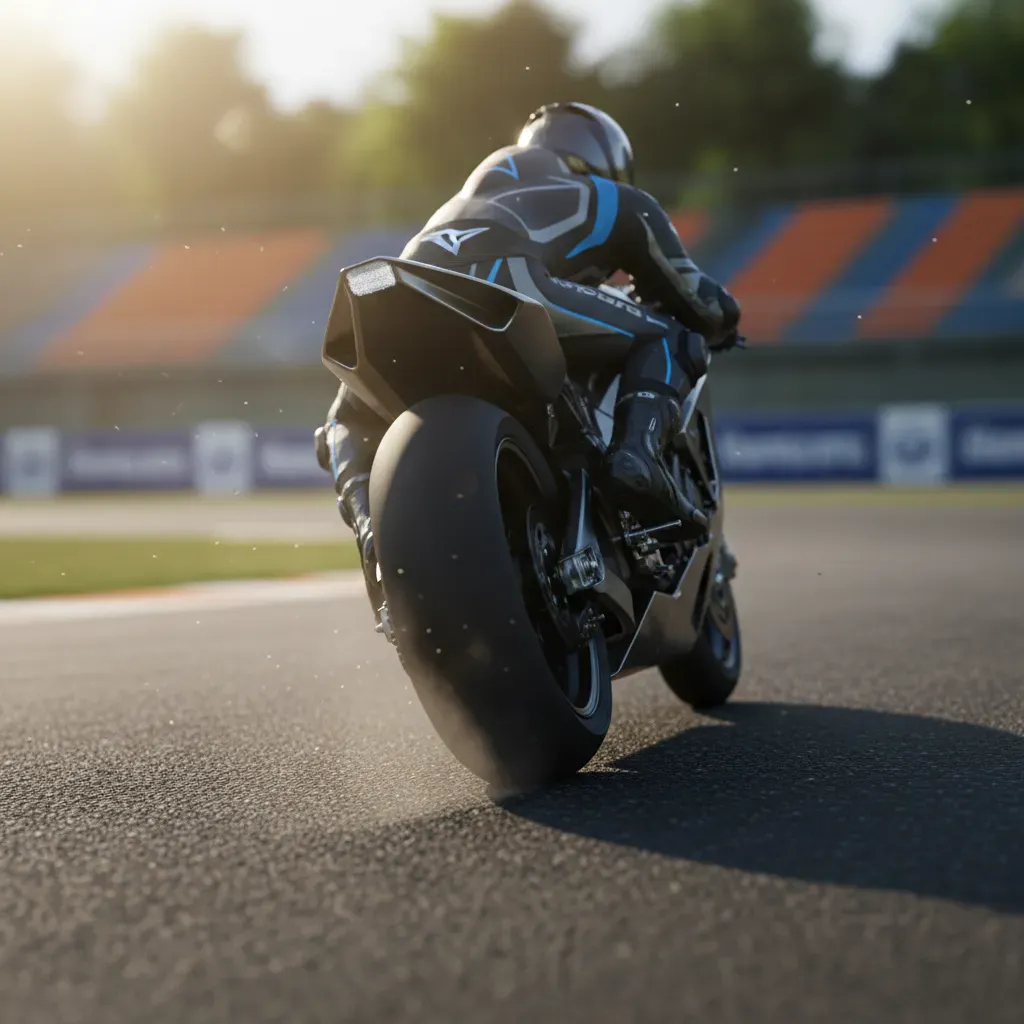
To understand why slicks work so well, we need to talk about the contact patch. This is the small area of the tyre that is physically touching the track at any single moment. For a MotoGP bike leaned over in a corner, this patch can be as small as a credit card.
Think of it like trying to push a heavy box across a polished wooden floor. If you do it in your socks, you’ll just slide. But if you put on a pair of trainers with wide, flat rubber soles, you get much more grip. The bigger the area of rubber touching the floor, the better your purchase.
A slick tyre works on the same principle. Its perfectly smooth surface puts the maximum possible amount of rubber in contact with the tarmac. More rubber on the road equals more grip, and in MotoGP, grip is everything.
So, Why Do Road Tyres Have Grooves?
The grooves on a normal tyre, known as ‘tread’, have one crucial job: to clear water. When you ride or drive in the rain, the tread acts like a system of channels, pumping water out from underneath the contact patch so the rubber can stay in touch with the road.
On a dry racetrack, there is no standing water to clear away. In this situation, any grooves or patterns would simply be wasted space – areas where rubber is not touching the asphalt. By removing the tread entirely, a slick tyre ensures that 100% of its surface is dedicated to providing grip.
Of course, if it does start to rain during a race, slicks become incredibly dangerous. Riders will immediately come into the Pit laneThe slow lane beside the track where teams work on the bikes and riders enter and exit.Read the full guide → to swap to special ‘wet’ tyres, which are covered in deep grooves designed to handle the water.
Not All Slicks Are The Same: The Compound Game
Here’s where the strategy comes in. A slick tyre isn’t just a single type of rubber. The teams and their tyre supplier, Michelin, provide different types of slick tyres for each race, known as different compounds. A compound is essentially the recipe of rubber and other chemicals used to make the tyre.
Imagine you have two sticky notes. One is super sticky and pulls the paint off the wall, but you can only use it once. The other is less sticky, but you can reuse it ten times. Tyre compounds are a bit like that; they offer a trade-off between ultimate grip and how long they last.
Michelin makes slicks in three compounds: Soft, Medium, and Hard. At most races, riders get two of these options for each tyre (with a third front option at some particularly demanding circuits), chosen to suit that track.
The Soft Tyre
This is the stickiest, grippiest, and fastest option available. The rubber is very soft, which allows it to warm up quickly and mould itself to the track surface, providing phenomenal grip. The major downside is that it wears out very quickly. A rider might use a soft tyre to get a fantastic start, but they risk the tyre’s performance dropping off dramatically towards the end of the race.
The Hard Tyre
This is the endurance athlete of the tyre world. Its tougher compound means it takes longer to get up to the ideal temperature and it offers slightly less outright grip than the soft. However, its huge advantage is its durability. It can last a full race distance with very consistent behaviour, making it a safer and often more predictable choice.
The Medium Tyre
As you can probably guess, the medium tyre is the all-rounder. It aims to offer the best of both worlds: good grip that is close to the soft tyre, but with much better durability. It’s a very popular choice and is often seen as the default or ‘safe’ option for many riders and races.

A High-Stakes Strategic Choice
The decision of which tyre compound to use is one of the most critical parts of a race weekend. A rider and their team must analyse the track temperature (hotter tracks wear tyres out faster), the rider’s personal style, and how their specific bike behaves.
Choosing the wrong tyre can ruin a race. A gamble on the soft might pay off with an early lead, or it could end in disaster as the rider is forced to slow down with a worn-out tyre in the final laps. This constant calculation of risk versus reward is what makes MotoGP so fascinating to watch.
So, the next time you see a MotoGP bike, you’ll know that its smooth tyres aren’t a design flaw. They are a purpose-built tool, a key piece of strategy, and the very foundation of the incredible speeds that make this sport the spectacle it is.
Quick Takeaways
- MotoGP bikes use smooth ‘slick’ tyres in dry conditions because they provide the most grip.
- A slick tyre maximises the ‘contact patch’ – the amount of rubber touching the track at any one time.
- Tread grooves, seen on road tyres, are only for clearing water in the rain; they reduce grip on a dry surface.
- Riders choose between different rubber ‘compounds’ (Soft, Medium, Hard), balancing outright speed against durability in a crucial strategic decision.