Jargon Buster
What is a Red Flag in MotoGP?
Ever seen a MotoGP race suddenly stop? Learn what a red flag means, why it’s used, and what happens next in our jargon-free beginner’s guide.
Independent fan site — not affiliated with MotoGP or MotoGP Sports Entertainment Group (formerly Dorna). Written by AI from official data and fact-checked: how this article was made.
The Ultimate Stop Sign
Imagine the scene: you’re glued to the screen, watching twenty-two of the world’s best riders battle at over 200 miles per hour. The noise is incredible, the action is intense, and then… everything stops. The bikes slow down, the frantic pace evaporates, and the riders begin cruising back to their garages. What just happened? You’ve just seen a red flag.
In the world of motorsport, flags are the primary way officials communicate with riders on track. A Yellow flagA warning of danger ahead — slow down and do not overtake in that zone.Read the full guide → means danger ahead, a blue flag means let a faster rider pass. But the red flag is the most important and serious of them all.
Red Flag: The most serious signal in racing, meaning the session or race must be stopped immediately.
When you see officials around the circuit waving big red flags, and the red lights around the track come on, it means conditions have become too dangerous to continue safely. It’s an order, not a suggestion. The race is stopped immediately, and every rider must slow down and ride back carefully to the Pit laneThe slow lane beside the track where teams work on the bikes and riders enter and exit.Read the full guide →, which is the area where the team garages are located.
Why Is a Race Red-Flagged?
A red flag is never thrown lightly. The decision is made by the Race Director, who leads Race Direction (the group of senior officials who run the event), and it only happens when rider safety is compromised. There are three main reasons why you might see a race stopped.
A Major Accident
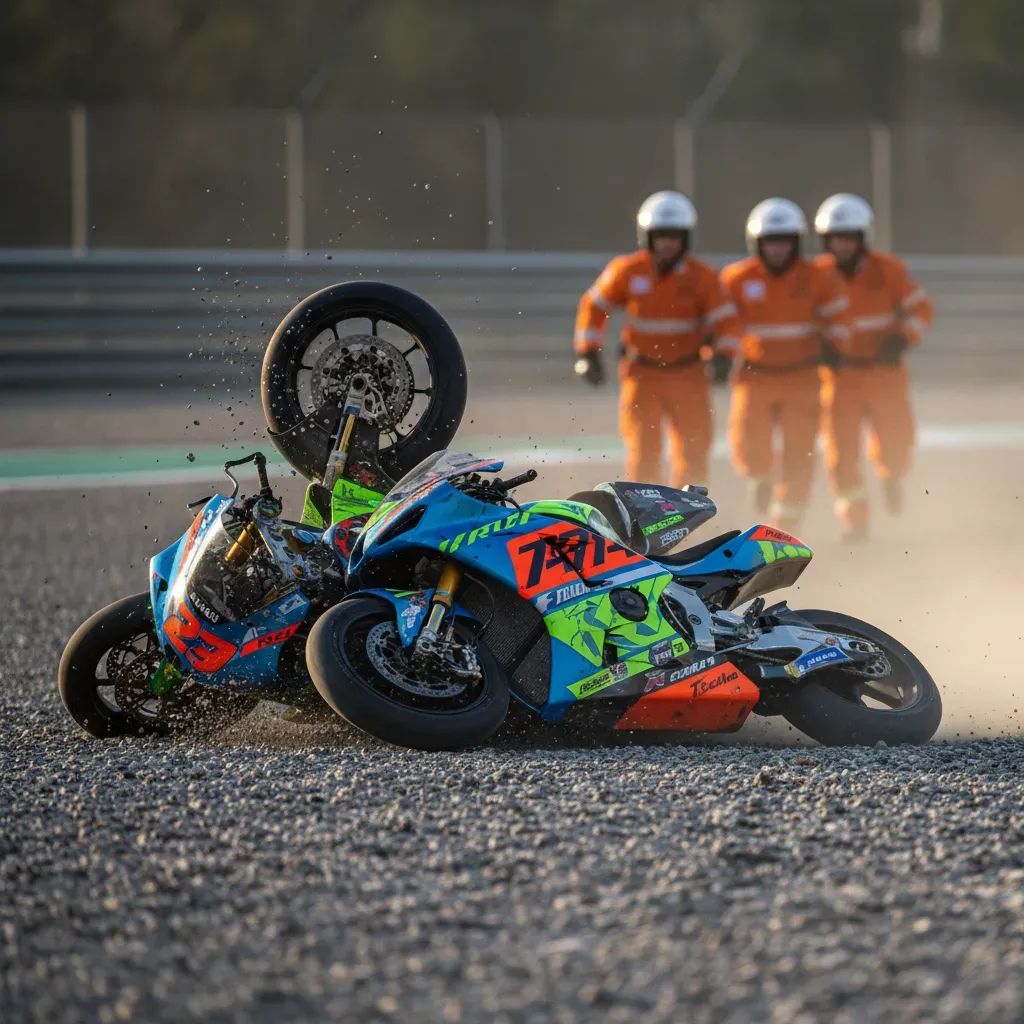
This is the most common reason. While MotoGP sees its fair share of crashes, most involve a single rider who slides off into a gravel trap, away from the Racing lineThe fastest path through a corner — usually wide on the way in, clipping the apex, then wide again on the way out.Read the full guide →. The track marshals, the brave volunteers in orange overalls, can usually handle this under yellow flags while the race carries on.
However, if there’s a multi-bike pile-up, especially on a high-speed section of the track, a red flag is essential. An accident might leave bikes, debris, or fluids like oil on the racing surface, creating a massive hazard for other riders. Stopping the race allows medical teams to attend to any injured riders and gives marshals the time and safe space they need to clear the track properly.
For example, a first-corner crash that leaves several bikes lying across the track would be an instant red flag situation.
Dangerous Weather
MotoGP bikes are fitted with incredibly specialised tyres. ‘Slick’ tyres, which have no tread pattern, are used in the dry for maximum grip. ‘Wet’ tyres, which have deep grooves, are used in the rain to clear water away.
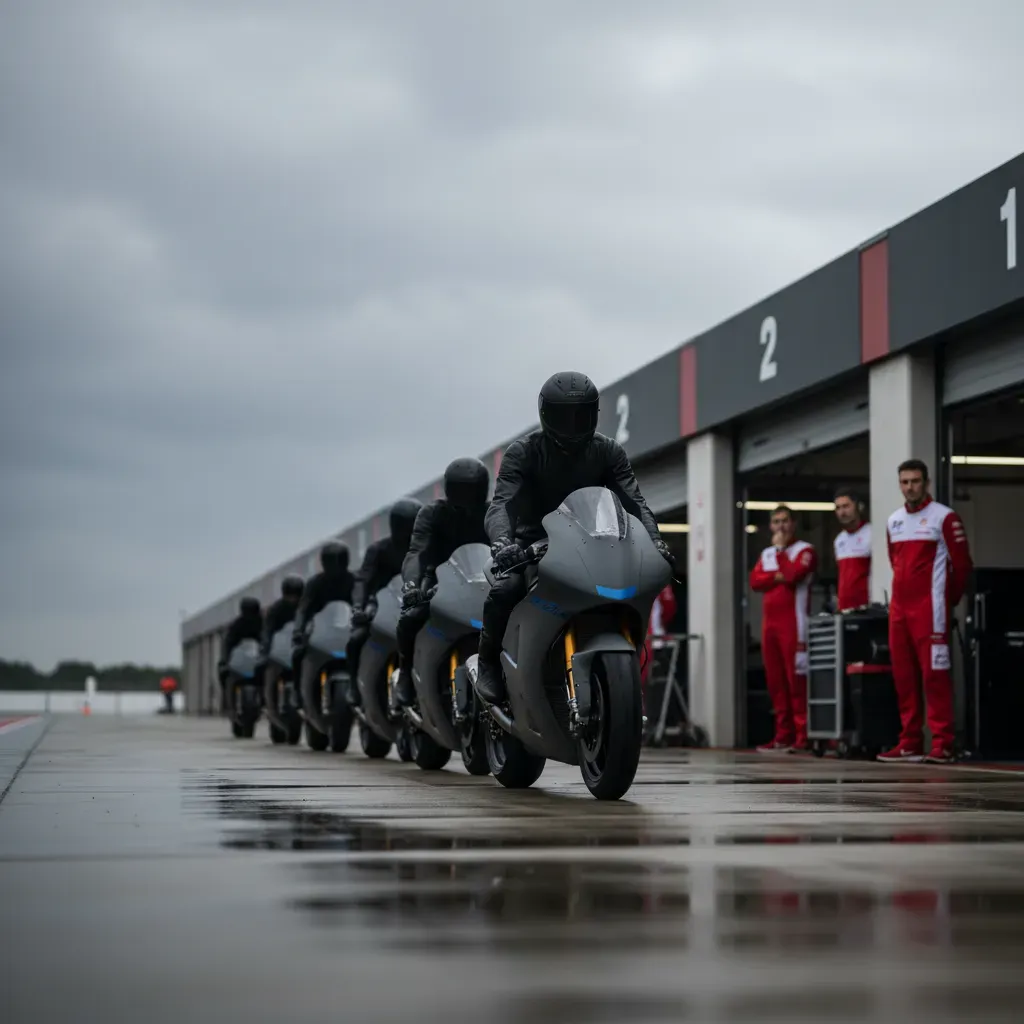
You might expect a rain shower to stop a race, but in MotoGP it usually doesn’t. The rules say a MotoGP race is not stopped just because the weather changes. Instead, marshals show White flagA flag signalling that riders may swap to a second bike — usually as rain arrives.Read the full guide → to warn riders that rain is falling, and riders can come into the pit lane and swap to their second bike, which is ready and fitted with Wet tyresGrooved tyres that channel water away so the bike can grip a wet track.Read the full guide →. This is called a Flag-to-flagA race where the weather changes and riders pit to switch bikes without the race stopping.Read the full guide →.
The red flag only comes out for weather when conditions become genuinely dangerous, such as rain so heavy that water stands on the track and bikes start aquaplaning (the tyres skate on a layer of water instead of gripping the road).
The smaller classes are different. Moto2 and Moto3 riders don’t have a second bike to swap to, so if rain arrives during a race that was declared dry, Race Direction stops the race to let everyone fit wet tyres. The restarted race is then automatically declared a wet race, which means it won’t be stopped for rain again.
Track Surface Issues
This is less common, but equally serious. The race could be stopped if there’s a problem with the circuit itself. This could be a patch of oil or coolant dropped by a bike with a mechanical failure, which would make the tarmac dangerously slippery.
In rare cases, there might be damage to the track surface or the safety barriers that needs urgent repair. In any of these scenarios, the red flag comes out to ensure the circuit is safe before racing resumes.
What Happens After a Red Flag?
Every rider has to make it back to the pit lane within five minutes of the red flag. Anyone who doesn’t won’t be classified. The running order is then frozen at the last full lap the leader completed before the red flag appeared.
What happens next depends on how much of the race has been run:
- Fewer than three laps completed: the race doesn’t count at all. It is restarted from scratch from the original grid, over a shorter distance (one lap fewer in MotoGP).
- Three laps or more, but less than three-quarters of the race: the race is restarted. The riders line up in the order they were running when it stopped, and the second part covers the laps that were left, with a minimum of five laps.
- Three-quarters of the race or more: the race is over. The frozen running order becomes the final result, with full championship points.
These numbers are for MotoGP. In Moto2 and Moto3 the key cut-off is two-thirds of the race distance rather than three-quarters.
Restarts happen quickly. Race Direction aims to begin the new start procedure within ten minutes of the red flag, conditions permitting. The pit lane opens for just 60 seconds, the riders do one lap to the grid and a Warm-up lapThe lap to the grid before the start, used to heat the tyres and brakes.Read the full guide →, and the race starts again.
If the race can’t be restarted, because the track can’t be made safe or the weather won’t improve, the outcome depends on how far it got. Stopped before three laps, it is cancelled and counts for nothing. After that, the result stands, with half points if less than half the race distance was completed and full points if half or more was completed.
The Red Flag You See at Every Start
Here’s a detail that can confuse new fans: you’ll see a red flag at the start of every race, even when nothing has gone wrong. At the end of the lap to the grid, an official holds a red flag completely still at the back of the grid, and at the end of the warm-up lap another is held still at the front.
A red flag held still like this is a signal to stop and take up position on the grid, not an emergency. It’s the waved red flag, shown all around the circuit, that means the race has been stopped.
In the end, the red flag is the ultimate safety tool, prioritising the well-being of the riders and marshals above all else. It might interrupt the spectacle, but it ensures everyone can come back to fight another day.
Quick Takeaways
- A red flag is the most serious signal in MotoGP, meaning the race or session must stop immediately due to dangerous conditions.
- Common causes are major accidents that block the track, oil or debris on the surface, and weather so extreme that racing is unsafe.
- Rain on its own doesn’t stop a MotoGP race. Riders swap to a second bike on wet tyres instead, although Moto2 and Moto3 races declared dry are stopped so riders can fit wet tyres.
- When a red flag is shown, all riders must slow down and return carefully to the pit lane.
- What happens next depends on distance: under three laps, a full restart; under three-quarters in MotoGP, a restart for the remaining laps; three-quarters or more, the race is finished with full points.